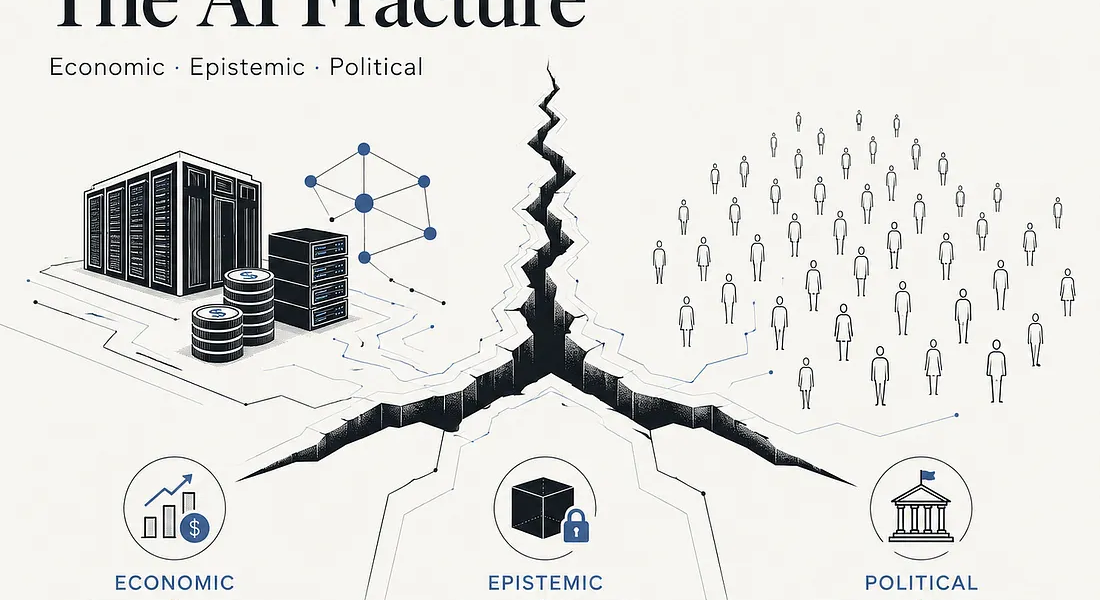
AI inequality is not a distant or theoretical risk. It is already taking shape across the economy, our information systems, and democratic institutions.
There is a particular anxiety that accompanies a technology you cannot understand but cannot escape.
It is not the fear of the unfamiliar — that fades with time. It is the fear of asymmetry: the growing suspicion that the world is being redesigned by and for a small group of people, and that the rest of us are simply being asked to live in it.
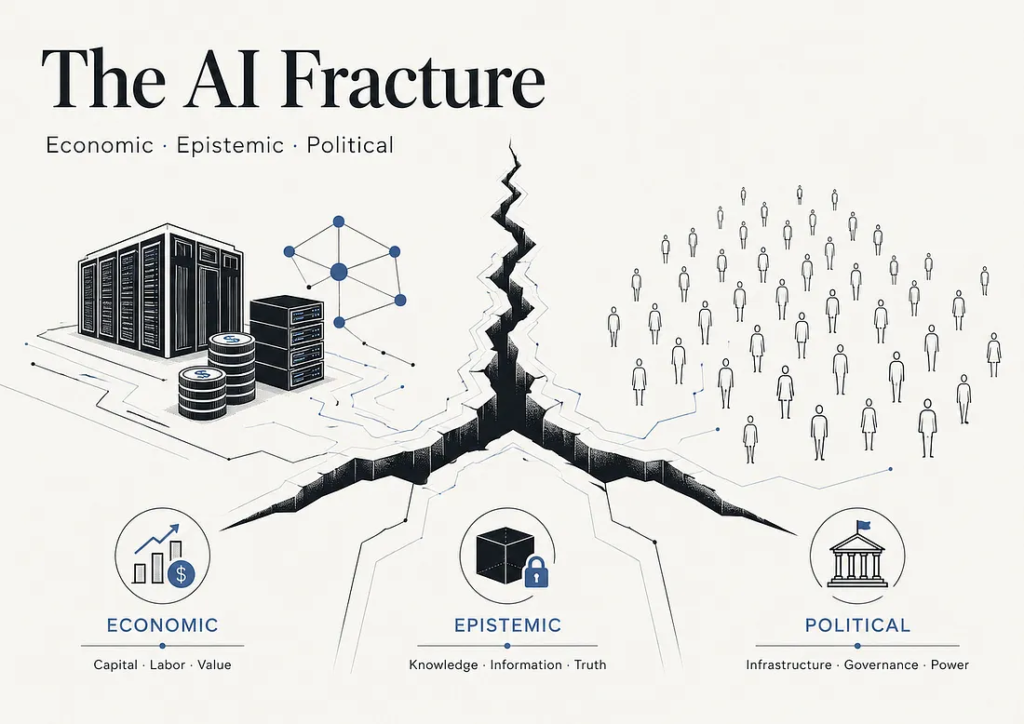
Artificial intelligence is producing exactly this kind of asymmetry. Not in one dimension, but in three — economic, epistemic, and political — each reinforcing the others in ways that risk producing the deepest social fracture of the century.
I. The Economic Fracture: Capital Wins, Labor Waits
The first and most visible divide is material.
This is the economic face of AI inequality: productivity gains may be widely produced while ownership and financial returns remain narrowly concentrated.
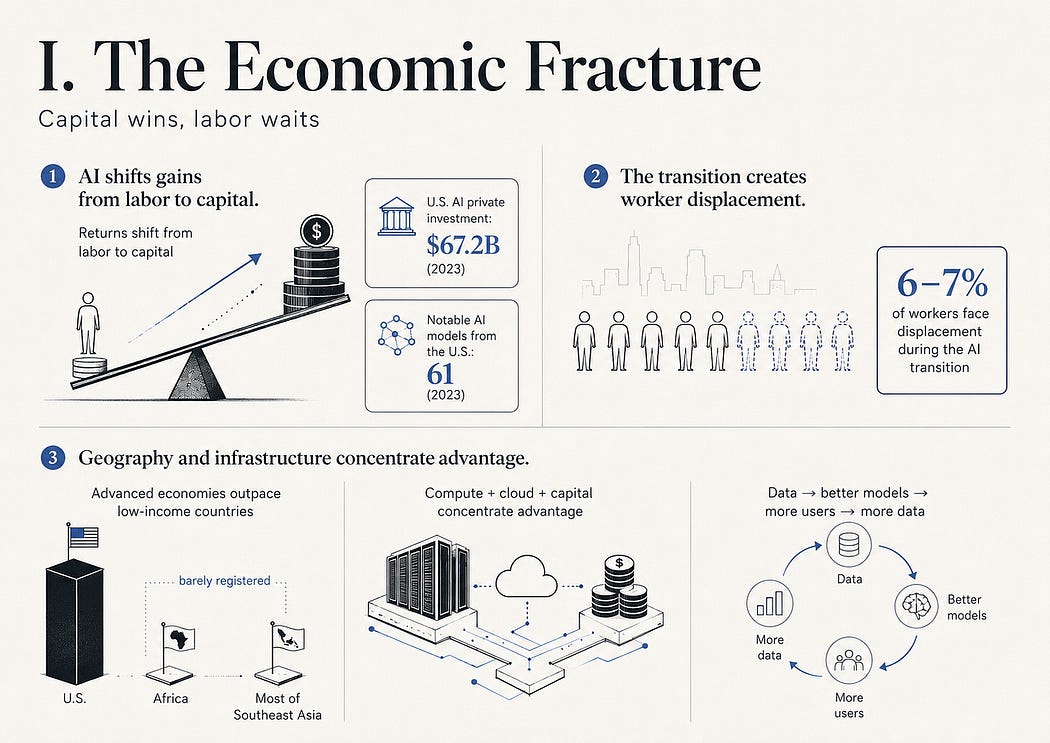
AI does not distribute its gains equally. It amplifies returns to capital — to those who own the models, the infrastructure, the data.
What the numbers confirm:
- A 2025 IMF working paper on AI adoption and inequality confirmed what many suspected: the technology shifts earnings from labor to capital holders, enriching shareholders while leaving workers with the uncertain promise of future opportunity.
- Goldman Sachs estimates that 6 to 7 percent of workers face displacement during the AI transition period — a number almost certainly growing as agentic systems move up the skills ladder.
- In 2023, the United States alone attracted $67.2 billion in AI-related private investment and produced 61 notable AI models. The entire African continent and most of Southeast Asia barely registered.
A UNDP report published in late 2025 warned bluntly that AI risks “sparking a new era of divergence,” reversing decades of narrowing development gaps between nations. Advanced economies could see AI’s growth impact at more than twice the rate of low-income countries — not because those countries lack intelligence or ambition, but because they lack compute, cloud infrastructure, and the capital to buy their way in.
The optimists argue that technology democratizes over time. That may be true. But “over time” is doing enormous work in that sentence. In the interim, the gap does not wait.
Companies with the most data build the best models, which attract the most users, which generate the most data — a feedback loop that concentrates advantage at a speed most regulatory frameworks cannot match.
The winners of the AI economy, as things currently stand, are not talented workers. They are energy companies, data center owners, and a handful of frontier model labs. The rest are downstream of their decisions.
Without deliberate intervention, AI inequality becomes self-reinforcing: greater access produces better systems, and better systems attract even more capital, infrastructure, and influence.
II. The Epistemic Fracture: Those Who Understand and Those Who Are Subjected
The second divide is less visible but may prove more durable.
AI inequality is therefore not only about income or access. It is also about who can understand, question, and challenge the systems making consequential decisions.
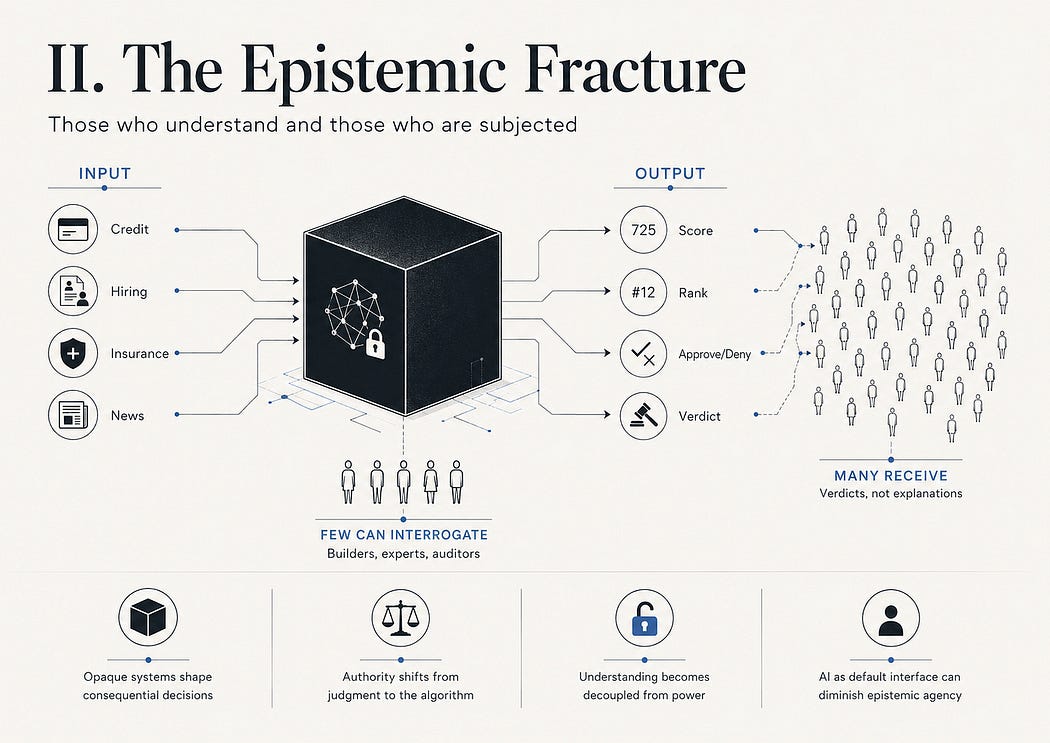
We are living through a moment in which systems of increasing consequence are legible to fewer and fewer people. The model that decides your credit application, ranks your résumé, scores your insurance risk, or surfaces your news is not merely opaque — it is, by design, irreducibly complex. Even the engineers who build these systems frequently cannot explain why they produce the outputs they do.
This creates a new kind of social stratification: not between those who have and those who do not, but between those who can interrogate the systems that govern their lives and those who simply receive their verdicts.
As a 2025 study on epistemic authority and AI noted, when both teachers and students defer to the same algorithmic tool, authority no longer flows from human judgment — it flows from the algorithm. Understanding becomes decoupled from power.
There is a subtler version of this problem too. As AI becomes the default interface for information, it shapes not just what we know but how we come to know things — the formation and revision of our beliefs. Research published in 2025 warned that AI risks “diminishing our epistemic agency,” nudging us toward intellectual passivity at the precise moment when the stakes of critical thinking are highest.
This form of AI inequality weakens individual agency by separating the people affected by automated decisions from the knowledge required to contest them.
“We don’t need an AI that kills us all in ten years to know that AI is already killing us today — through unemployment, surveillance, disinformation, and the concentration of power.” — Meredith Whittaker, Web Summit Lisbon, November 2025
The epistemic fracture compounds the economic one. The people most likely to understand AI systems are the same people building them — and profiting from them. Everyone else navigates an increasingly AI-mediated world armed with intuitions that were formed for a different one.
III. The Political Fracture: The Techno-Oligarchy and Its Discontents
The third divide is structural, and it may be the most dangerous.
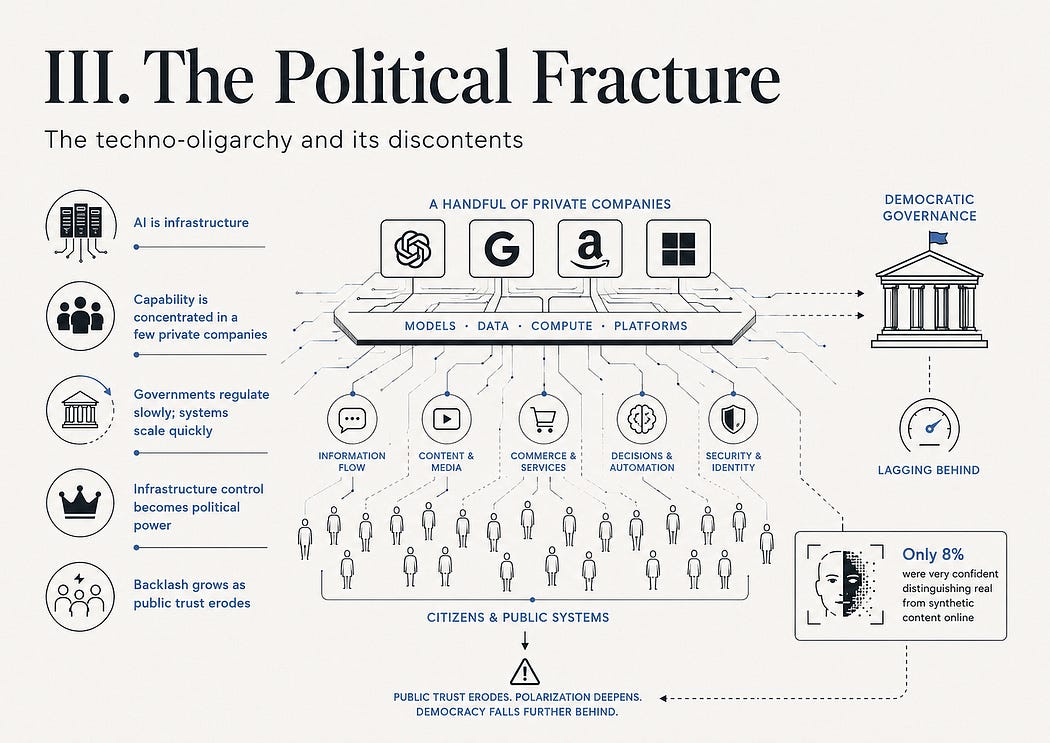
AI is not merely a technology. It is infrastructure — the kind that, once embedded, becomes indispensable. And infrastructure, historically, does not stay neutral. Whoever controls the pipes controls what flows through them.
The concentration of AI capability in a handful of private companies has created what commentators across the political spectrum have begun calling a techno-oligarchy: a small group of individuals whose control over communications infrastructure, credit systems, information flows, and increasingly autonomous decision-making gives them a form of power that has no adequate legal or democratic counterpart.
Carnegie Endowment research on AI and democracy published in January 2026 documented in granular detail how AI amplifies existing threats — misinformation, polarization, repression — while adding new ones. Only 8 percent of Californians surveyed in summer 2025 reported being “very confident” in their ability to distinguish real from synthetic content online.
The political economy of AI is producing a strange inversion. Democratic governments, designed to be slow and deliberate, are trying to regulate systems whose capability doubles on timescales of months. The companies building those systems have more technical expertise than the institutions trying to govern them, and they have strong financial incentives to shape the governance conversation in their favor. The result is a kind of regulatory capture at civilizational scale.
Meanwhile, the populist backlash is brewing. Time reported in early 2026 that if AI takeoff accelerates as expected, the gap between “tech oligarchy promises and Main Street reality” could become the defining political fault line of the decade. This is not a distant risk. It is visible now in rising skepticism toward AI products, in legislative battles over algorithmic accountability, and in the growing public intuition — however inchoate — that something important is being decided without them.
The Shape of the Fracture
What makes the AI divide different from previous technological disruptions is not its magnitude but its simultaneity.
The Industrial Revolution restructured economies over generations, giving societies time — imperfect, often brutal — to adapt. AI is compressing that timeline dramatically while operating across economic, cognitive, and political dimensions at once.
The fracture is not between humans and machines. It is between humans who shape AI and humans who are shaped by it. Between societies that export AI systems and societies that import decisions. Between those who can afford to opt out and those for whom the algorithm is the only institution they ever interact with.
None of this is inevitable. The choices made now — about ownership, transparency, taxation, access, and democratic accountability — will determine whether AI becomes the great amplifier of human flourishing or the most efficient mechanism for inequality ever built. The technology itself is indifferent. The fracture is not.
What is required is not luddism, nor uncritical acceleration, but something harder: a politics serious enough to match the scale of the transformation underway.
History suggests we are not very good at this. History also suggests we have no choice but to try.
💬 What about you?
Where do you see this fracture showing up in your own life — at work, in the news you consume, in decisions being made without you?
Tell me in the comments — the best follow-up pieces usually come from those conversations.
If this piece made you think, share it with someone who should read it.